1. What is an abacus course, and how does it work?
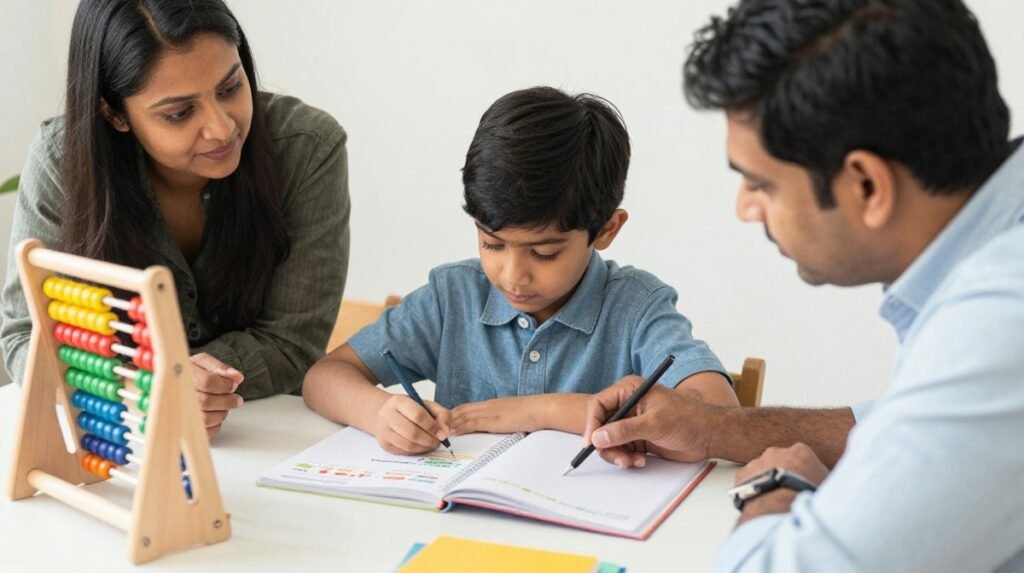
An abacus course introduces children to numbers and arithmetic using a physical counting frame. The teacher shows how beads represent quantities and guides students through simple sums before moving to bigger challenges.
At first, kids work directly with the frame. They learn bead positions, finger movements, and how each shift changes a number.
A child might start by showing 5, then 8, and then 12. Once those numbers stick, the teacher introduces simple addition and subtraction.
What do children learn in beginner abacus classes?
A beginner course covers essential arithmetic fundamentals:
- Recognizing numbers and placing them on beads.
- Understanding basic place value like ones, tens, and hundreds.
- Working through basic addition and subtraction.
- Following calculation steps in the correct order.
- Listening to instructions during guided drills.
- Checking answers and fixing errors independently.
- Building calculation speed and confidence through regular practice.
Syllabi vary by center. Ask for a course outline before enrolling your child.
How does a typical lesson work?
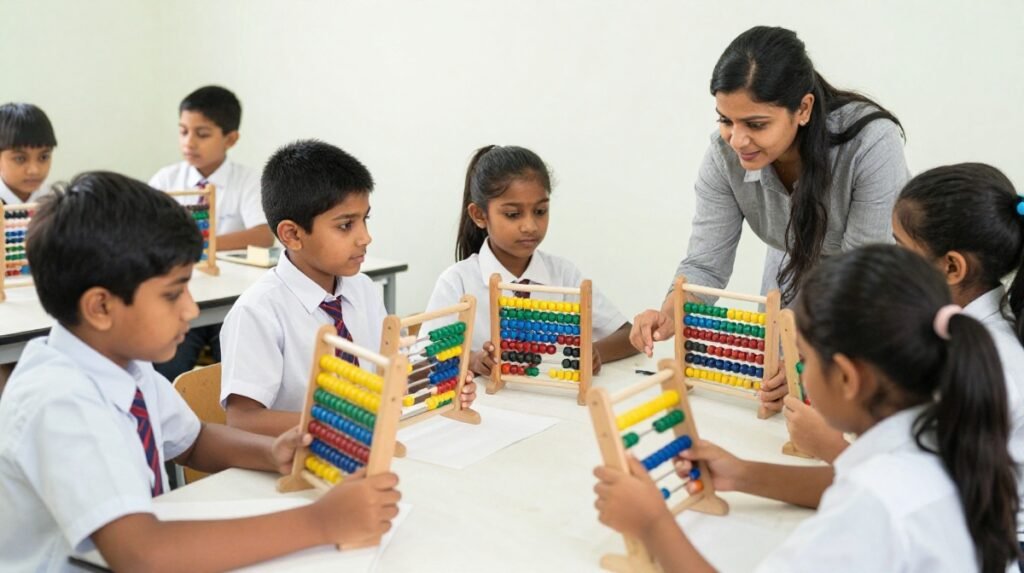
Classes usually start with a quick review of the previous topic. The teacher demonstrates a new technique, shows the bead moves, and lets students try it out.
For example, kids might start with single-digit addition. Once they get the hang of it, they work through worksheets on their own.
Good instructors check for real understanding instead of asking kids to memorize movements blindly.
Quick answer: An abacus course teaches children to represent numbers using beads and solve arithmetic problems. Beginner classes start with number recognition and move into simple addition and subtraction.
2. Why should parents consider abacus classes for beginners?
Kids learn maths at different speeds. Some grab abstract ideas fast, while others need physical tools to make sense of numbers. An abacus gives them a tactile way to calculate, making early maths far more approachable.
When evaluating IPL Abacus Training in Koodalnagar Madurai, look at the core skills your child will build and how the program tracks growth.
Better understanding of numbers
Young kids often memorize answers without knowing why they work. An abacus makes abstract numbers concrete through physical movement. Research published by the National Center for Biotechnology Information shows that visual and spatial tools like the abacus help children build stronger mental representations of numerical values. Explore the overall benefits of abacus learning for children to understand how tactile methods influence cognition.
When a child adds 4 + 3, they physically shift four beads and then three more. Counting the total connects the physical action directly to the written sum. That hands-on connection makes addition clear. As kids grow comfortable, they apply the same logic to bigger problems.
More opportunities to practise concentration
Abacus drills force kids to listen, follow steps, and move specific beads accurately. It gives them regular practice focusing on one task at a time.
You can support this habit at home by setting up a quiet study spot and keeping practice times short. Attention spans grow through many daily activities, but structured exercises provide a solid starting point.
Regular calculation practice
Repetition helps kids get comfortable with arithmetic. Teachers introduce small exercise sets, verify answers, and dial up the difficulty over time.
Beginners usually start with simple addition before touching subtraction. Once kids master those, teachers move them to harder exercises according to the syllabus. The goal is steady progress. Kids need enough time to digest one step before jumping to the next.
Confidence through small achievements
Maths anxiety is real for young kids. Starting with simple, manageable sums gives them room to learn without unnecessary stress.
Praise effort, careful work, and progress rather than perfect scores. When your child makes a mistake, walk through the step again and let them retry. Avoid comparing your child’s speed with other students. Everyone moves at their own pace.
A practical introduction to structured learning
Abacus classes help kids get used to classroom routines, guided tasks, and practice schedules. These habits support general school performance.
Just remember that abacus training complements school maths. It does not replace school lessons, homework, or basic logic. Educational guidelines published by UNICEF Education stress that foundational learning thrives best when supplementary activities reinforce standard classroom studies rather than replacing them.
What parents should remember: Abacus learning gives kids structured arithmetic practice and hands-on number work. Real results depend on good teaching, active student participation, and steady home practice.

3. How to choose the right IPL abacus course for beginners
Picking a center takes more than reading a brochure. You need to know how lessons run, what kids learn, and how progress gets tracked.
If you are looking at IPL Abacus Training in Koodalnagar Madurai, keep these points in mind when you call or visit.
Check the beginner syllabus
Ask what children learn in their first month. A clear outline shows if the level matches your child’s current skills.
Make sure the beginner level covers:
- Number recognition and bead setup.
- Simple addition and subtraction.
- Place-value concepts.
- Guided practice and regular reviews.
- Frequent checks for understanding.
- A clear path to the next level.
Ask how teachers decide a child is ready to move up. Students need solid footing before tackling harder sums.
Understand the teaching method
Kids do best with clear demonstrations, real examples, and time to practice on their own.
Ask how teachers handle kids who need extra help. A good program gives children space to ask questions and fix mistakes without feeling rushed.
If the center offers a trial class, take it. Watch how the teacher interacts with the kids and explains new ideas.
Ask about class size and individual attention
Not every child gets a new calculation on the first try. Small class sizes mean teachers can spot mistakes and correct posture or finger technique quickly.
Ask these questions before signing up:
- How many students are in each batch?
- Can the teacher help struggling students individually?
- How does the center support slower learners?
- How do teachers share progress updates with parents?
The answers will tell you if the classroom environment fits your child.
Confirm the schedule and course fees
Classes must fit into your child’s routine without ruining their schedule. School, homework, play, and rest all come first.
Before enrolling at IPL Technologies, confirm these details directly with the center:
| What to check | Questions to ask |
| Course fees | What is the total cost, and are there extra charges for exams or books? |
| Class schedule | Which days and time slots are open? |
| Course duration | How many months or hours does each level take? |
| Learning materials | Are the abacus frame and workbooks included in the fee? |
| Assessments | How often do teachers evaluate progress? |
| Certificates | Is a completion certificate provided, and what are the rules to get it? |
| Trial class | Can my child attend a demo session first? |
Fees, schedules, and batch slots change over time. Verify current details directly with the center before making a decision.
Look for clear communication with parents
You should always know what your child is learning and where they struggle.
Ask if the center provides regular updates, practice tips, or feedback after tests. Honest communication helps you support your child at home.
The right course matches your child’s pace, offers good guidance, and builds a sustainable routine. Explore our IPL abacus course for beginners in Koodalnagar, Madurai to see how our early levels are set up.
4. What happens in an abacus class? A beginner learning journey
An IPL abacus course for beginners introduces concepts gradually. While exact schedules depend on the center, most beginner programs follow a simple 5-stage path.
Stage 1: Abacus Basics ──> Stage 2: Simple Sums ──> Stage 3: Number Expansion ──> Stage 4: Mental Visualization ──> Stage 5: Progress Reviews
Stage 1: Getting familiar with the abacus
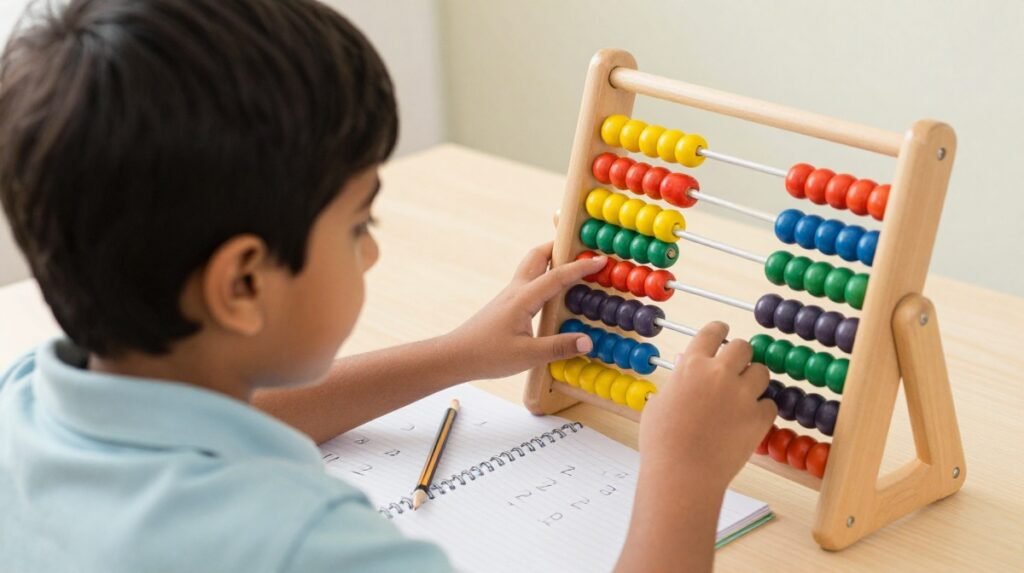
First, kids learn the frame, rods, and beads. They practice finger techniques to shift beads cleanly and represent basic numbers.
Rushing this stage causes confusion later. Teachers must make sure students master the basic mechanics first.
Stage 2: Learning simple calculations
Once kids can represent numbers, they move to simple math.
A teacher might demonstrate 3 + 2 like this:
- Move 3 beads up.
- Add 2 more beads.
- Count the total beads on the rod.
- Write down the result: 3 + 2 = 5.
Kids then practice similar problems until the motion becomes second nature.
Stage 3: Practising more number combinations
Next, teachers introduce two-digit numbers and longer calculations.
Students practice following exact bead sequences and checking their answers. Regular revision is vital here because new steps build directly on old ones.
Stage 4: Building calculation fluency
After students master the physical tool, many programs introduce mental arithmetic. Kids learn to picture the abacus in their heads and solve sums without touching a physical frame.
This takes time and patience. Children must master the physical abacus before attempting mental calculations.
Not every child reaches this stage at the same time. Ask the center how they guide kids through this transition.
Stage 5: Reviewing progress
Teachers use worksheets and short assessments to see what stuck. Use these moments to ask which skills your child mastered, which topics need work, and how you can help at home. Clear progression gives kids a sense of accomplishment without unnecessary pressure.
5. How parents can support abacus learning at home
Classroom instruction is only half the battle. Kids need brief practice at home to retain what they learn.
Home practice does not need to be long. A quick daily routine works far better than an hour-long cram session on the weekend.
Create a simple practice schedule
Pick a time when your child is well-rested. Depending on their age and attention span, 5 to 10 minutes a day is plenty for beginners.
Here is a sample weekly routine:
| Day | Suggested activity |
| Monday | Review number representation on the frame |
| Tuesday | Practice simple addition problems |
| Wednesday | Work through basic subtraction drills |
| Thursday | Review older examples to stay sharp |
| Friday | Complete one short practice page |
| Saturday | Revisit any tricky questions from the week |
| Sunday | Rest or do a light 5-minute review |
Adjust this schedule based on your child’s homework load and teacher recommendations. Try these abacus practice activities for beginners at home to keep practice sessions engaging.
Use the practice materials provided by the teacher
Stick to the methods taught in class. Introducing shortcut tricks or different techniques early on will confuse your child.
If your child repeatedly struggles with a specific problem, make a note and ask the teacher to explain it in the next lesson.
Encourage effort instead of speed
Parents often focus on how fast a child calculates. Accuracy and understanding matter far more.
Let your child work through the steps carefully. Speed comes naturally with practice, but rushing leads to messy errors. Praise your child for finishing their practice, asking good questions, or correcting a mistake on their own.
Keep practice calm and enjoyable
If your child is tired after school, scale back practice or review an easy topic they already know well.
You can also weave numbers into everyday routines. Ask your child to grab 6 spoons and add 2 more. It keeps math practical without feeling like an extra exam. Check out our detailed guide featuring tips for parents supporting children’s learning at home for simple ways to build study habits at home.
6. Common mistakes to avoid when enrolling a child
It is easy to make a few common missteps when picking a program. Avoid these traps to keep the experience positive.
Choosing a course based only on speed claims
Do not fall for marketing promises about instant math geniuses. Ask what the program actually teaches and how they measure success.
Learning depends on prior knowledge, attendance, teaching quality, and practice. No center can guarantee identical results for every child.
Expecting immediate improvement in school maths
Abacus classes focus on arithmetic speed and accuracy. School math covers geometry, word problems, measurements, and data interpretation too.
Your child might still need separate help with those topics. Keep reviewing schoolwork and talk to their schoolteacher if they struggle.
Comparing children with one another
One child might pick up bead moves in a day, while another needs two weeks. Comparisons crush confidence and turn learning into a stressful competition.
Compare your child only against their past work. Focus on their individual gains in accuracy and focus.
Overloading the child’s timetable
Packing every afternoon with classes exhausts kids. Schoolwork, sleep, free play, and family time must come first.
A balanced schedule yields far better results than a packed one that leaves no time to rest.
Skipping revision
Kids forget techniques quickly if they only open the workbook in class. Short, regular review sessions keep the skills fresh.
Ask the teacher how often your child should review and which exercises need extra attention.
Ignoring the child’s interest
Your child does not need to love every drill, but their feelings still matter.
Ask them what felt easy, what felt hard, and if they feel comfortable asking the teacher for help. If they feel overwhelmed every week, talk to the instructor.
7. Is an abacus course the right choice for your child?
An abacus course works well for kids who enjoy hands-on activities, need extra arithmetic practice, or want a visual way to handle numbers.
It also suits parents looking for structured math practice outside of school.
The best choice always depends on your child’s needs and the quality of the local program. You can also explore other educational courses for school students in Madurai to see how different enrichment programs compare.
An abacus course may be worth exploring if your child:
- Enjoys puzzles, counting games, and hands-on tasks.
- Is just learning basic number concepts.
- Needs extra practice with core arithmetic.
- Learns best through visual and physical demonstrations.
- Can commit to 5–10 minutes of daily practice.
Consider these points before enrolling
If your child struggles with basic counting, check if the center offers a true foundation level. If their schedule is already packed, check if adding classes will cause burnout.
Decide whether your goal is better basic math, mental arithmetic skills, or just an engaging after-school activity.
Taking a demo session helps you evaluate the teaching style before committing to a full term.
What results should parents expect?
Results vary widely. Guided practice helps kids master number placement and arithmetic, but real growth depends on starting skills, consistency, and teaching quality.
Abacus training is just one piece of a child’s education. Keep encouraging school math, reading, sports, creative play, and other interests.
Local Center Details & Contact Information
If you are interested in enrolling your child in IPL Abacus Training in Koodalnagar Madurai, visit or reach out to the center directly:
- Center Name: IPL Technologies / IPL Abacus Academy
- Location: Koodalnagar, Madurai, Tamil Nadu
- Services: Beginner Abacus Training, Mental Arithmetic, Practice Workbooks
- Inquiries: Contact the administrative desk to verify upcoming batch availability, open time slots, and trial class schedules.
Frequently asked questions
1. What is IPL Abacus Training in Koodalnagar Madurai?
IPL Abacus Training in Koodalnagar Madurai introduces young students to numbers and basic arithmetic using an abacus frame and mental visualization techniques. Contact IPL Technologies directly for their latest syllabus, eligibility, and schedule details.
2. At what age can children start learning abacus?
Most children can start around age 4 to 6, provided they recognize basic numbers from 1 to 10. Ask the training center about their age limits and entry requirements.
3. How long does it take to learn abacus?
Complete programs take anywhere from 1 to 3 years across multiple levels. Ask the center for their timeline and how they assess students at each level.
4. Does abacus learning help children with maths?
It builds strong mental arithmetic, speed, and focus. While it makes basic math easier, it does not cover the full school math curriculum like geometry or word problems.
5. How can I choose abacus classes in Koodalnagar, Madurai?
Compare syllabi, batch sizes, teaching methods, fees, schedule options, and parent feedback. Visit IPL Technologies in Koodalnagar to inspect the center and request a trial class.
Conclusion
Abacus learning gives children a tactile way to master numbers and build arithmetic fluency. With good instruction and brief daily practice, kids gain confidence in calculations and build strong study habits.
When exploring options for IPL Abacus Training in Koodalnagar Madurai, check the beginner syllabus, teaching style, fees, schedules, and progress tracking. These factors will help you make the right choice for your child.
To get started, contact IPL Technologies in Koodalnagar to ask about new batches, levels, and enrollment. Take your child along for a demo class to see if the environment fits.
The right course encourages curiosity, provides clear guidance, and lets your child learn at their own pace.